
CRM With Task Management: The Practical Guide
Introduction
You’re looking for a CRM automation with task management for one reason: you want less leakage.
Leads shouldn’t go cold because nobody followed up. Onboarding shouldn’t stall because one step got missed. Clients shouldn’t be asking, “What’s happening this week?” while your team searches chats and emails.
A CRM that also lets you create and assign tasks sounds like the simplest fix.
Here’s the practical truth: tasks inside a CRM are powerful for follow-ups and repeatable work, but they usually can’t replace all in one project management when delivery becomes complex.
This guide shows:
- what CRM task management does well
- where it breaks
- how SMBs set it up cleanly without chaos
Quick Chooser (30 Seconds)
Choose CRM task management if:
- your work is mostly checklists and due dates
- services are repeatable
- the main problem is missed follow-ups
You likely need real project management if:
- tasks have dependencies
- workload and capacity matter
- approvals and change requests are common
- delivery spans multiple workstreams
What “Task Management Inside a CRM” Usually Includes
Most CRMs support tasks in these ways:
1. Individual Tasks
Simple reminders like:
- call a lead
- send an email
- book a meeting
2. Deal-Stage Tasks
Tasks triggered by pipeline stages:
- proposal sent → follow-up
- deal won → kickoff checklist
3. Account / Contact Tasks
Relationship-based work:
- monthly check-ins
- renewal prep
- quarterly reviews
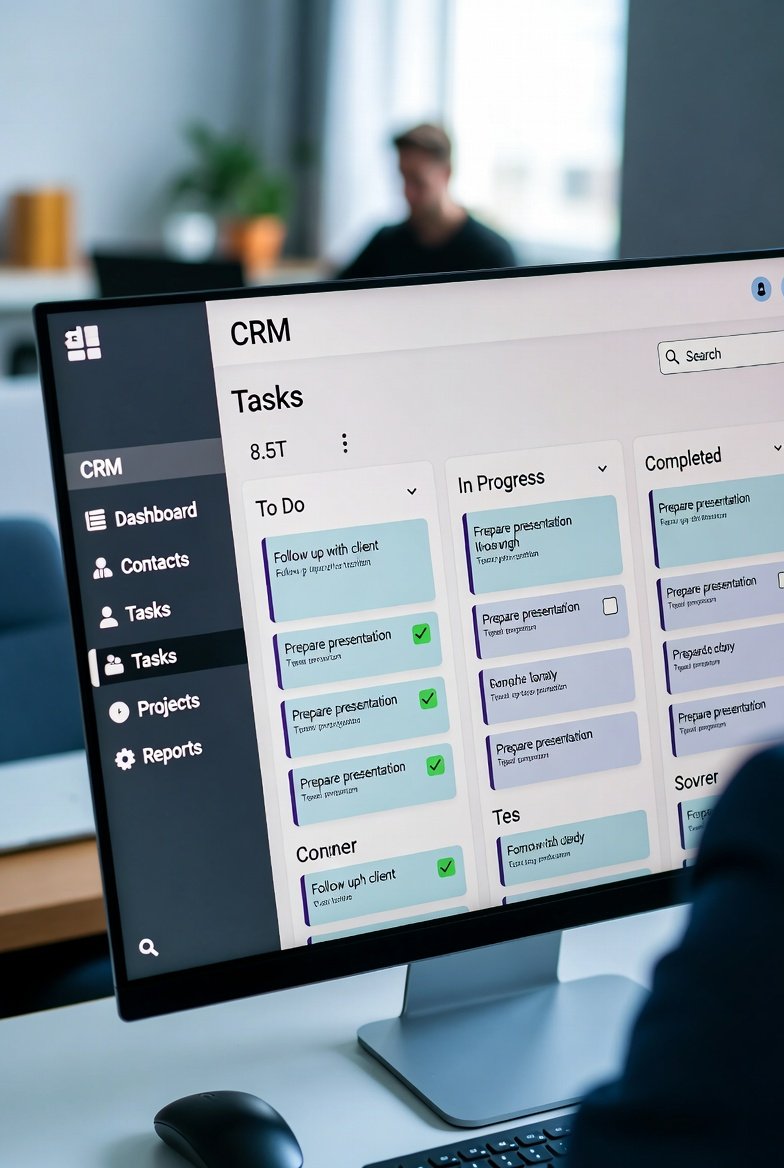
4. Simple Lists or Boards
Basic task views:
- To Do → Doing → Done
- often filtered by deal or client
For many SMBs, this is enough—if it’s configured properly.
Feature Checklist That Actually Matters
A CRM can “have tasks” and still fail in practice.
These features separate usable systems from frustrating ones.
- Task owner required
- Task due date required
- Recurring tasks
- Task templates by service or stage
- List + board + calendar views
- Automation triggers (deal won → tasks)
- Tasks linked to deals or accounts
- Notifications and reminders
Usually missing or weak:
- true dependencies
- workload / capacity views
When CRM Tasks Work (and When They Don’t)
Scenario 1: Agency With Retainers or Fixed Packages
CRM tasks work when:
CRM Implementation Timeline for SMBs
- services are templated
- onboarding steps repeat
You need PM when:
- projects have dependencies
- scope changes mid-delivery
Scenario 2: Local Service Business
CRM tasks work when:
- jobs are short
- steps are predictable
You need PM when:
- multiple crews are involved
- inventory or scheduling is complex
Scenario 3: Freelancer or Consultant (10–30 Clients)
CRM tasks work when:
- work is checklist-based
- relationship management is key
You need PM when:
- teams or collaborators are involved
Scenario 4: Onboarding + Customer Success
CRM tasks work when:
- onboarding is standardized
- renewal reminders matter
You need PM when:
- onboarding requires approvals or handoffs
Scenario 5: Operations-Heavy Delivery
CRM tasks work when:
- you only need a light checklist
You need PM when:
- delivery is the business
- timelines and dependencies drive success
Why CRM Tasks Fail in Real Life
Red Flag 1: Tasks Without Owners
If no one owns a task, it won’t happen.
Fix: One task = one owner.
Red Flag 2: Tasks Without Due Dates
A task without a due date is optional in practice.
Fix: Always require a due date.
Red Flag 3: Task Lists Become Dumping Grounds
When everything becomes a task, nothing feels important.
Fix: Limit task types to 8–12 standard actions.
Red Flag 4: Poor Data Hygiene
Messy records break automation and trust.
Fix: Run a small weekly hygiene routine.
The Clean Setup: CRM Tasks That Stay Usable
The 10-Minute CRM Task Test
Step 1: Run one real lead end-to-end
Lead → follow-up → proposal → deal won → kickoff tasks
Step 2: Enforce minimum required fields (8–12)
Examples: service type, owner, next step date
Step 3: Build 2 task templates
Use your top 2 services only
Step 4: Validate governance
Permissions, visibility, exports
If this works without spreadsheets, you’re good.
Minimum Viable CRM Task System (Template)
Standard Task Types (Pick 8–12)
- Call lead
- Send proposal
- Follow-up (48 hours)
- Schedule kickoff
- Collect documents
- Deliverable review
- Send invoice
- Monthly check-in
- Renewal review
Task Rules
- One owner
- One due date
- Must link to deal or account
- Statuses: To Do / Doing / Done
Weekly Hygiene (15 Minutes)
- Close stale tasks
- Update next steps
- Merge duplicates
- Review overdue tasks
AI and Automation (No Hype)
Automation helps only when basics are clean.
Most useful automations:
- assign tasks by service type
- create kickoff checklist on deal won
- remind owners of overdue tasks
- flag deals with no next step
AI summaries won’t fix broken workflows.
FAQs
Can CRM task management replace project management?
Sometimes—if work is repeatable.
Not if you need dependencies or approvals.
Is CRM with tasks enough for small teams?
Often yes, especially with templates and discipline.
How do I scale CRM tasks?
Add governance, not complexity.
Move to hybrid if delivery grows complex.
What’s the biggest risk?
Unowned, undated, free-form task lists.
Conclusion
CRM task management is excellent for:
- follow-ups
- onboarding checklists
- relationship care
But when delivery needs dependencies and coordination, CRM tasks alone will feel thin.
Best setups:
- Simple work → CRM tasks only
- Growing complexity → CRM + PM
- Heavy delivery → Dedicated PM with CRM handoff