
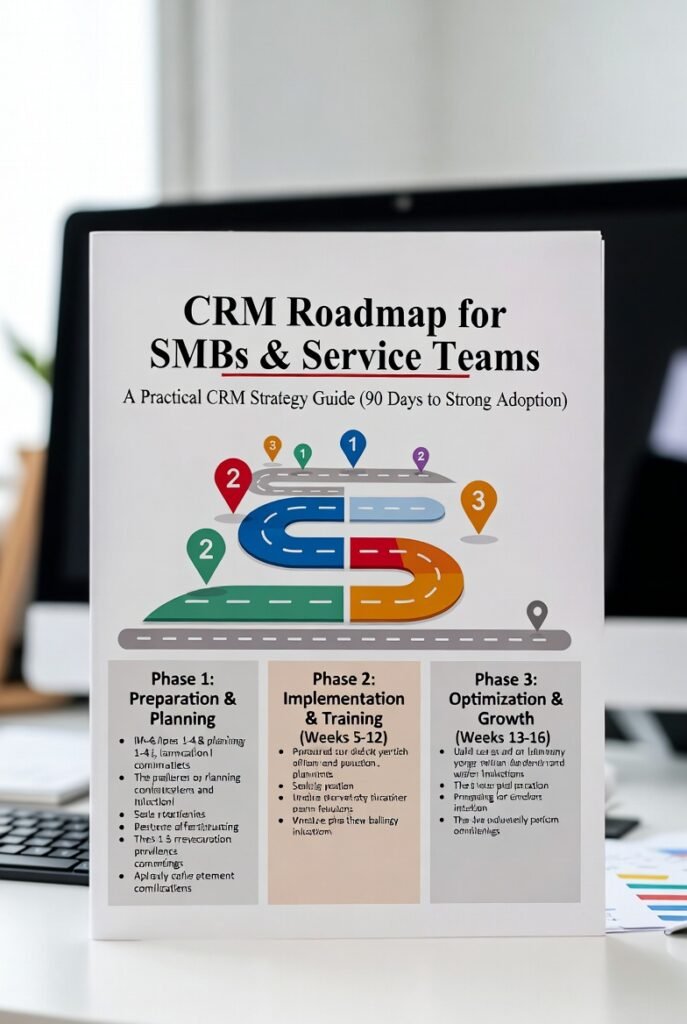
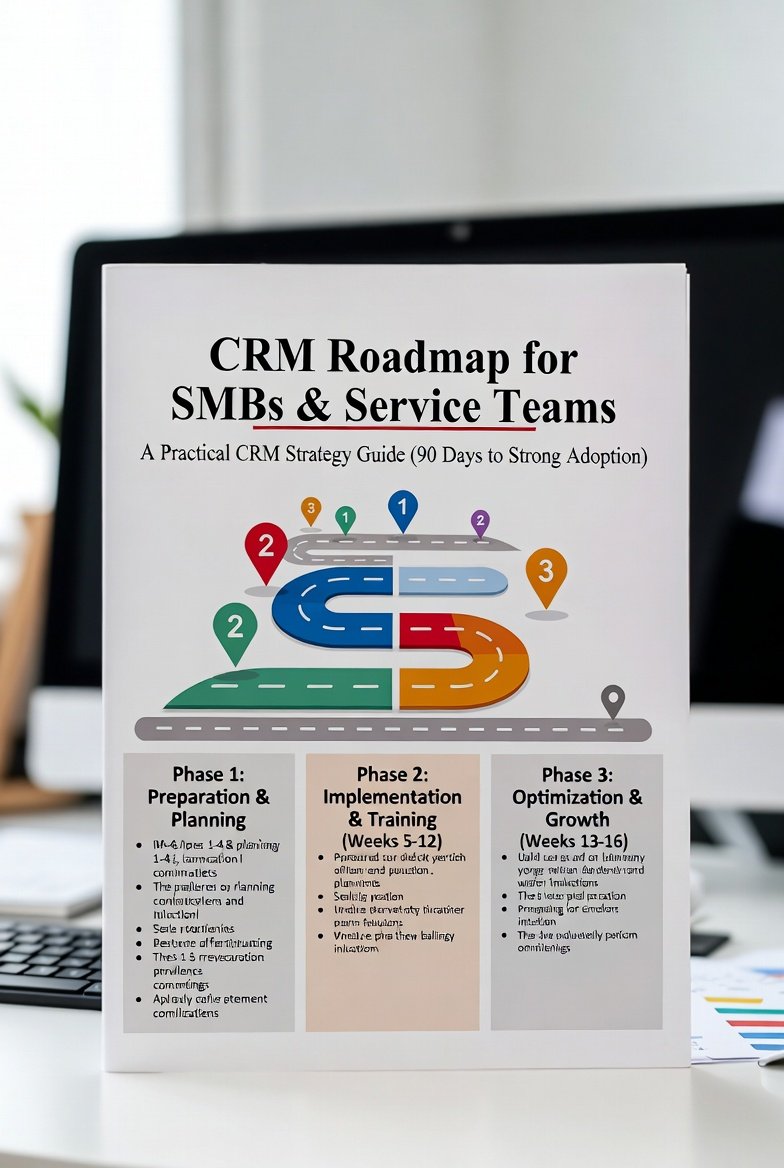
CRM Roadmap for SMBs & Service Teams: A Practical CRM Strategy Guide (90 Days to Strong Adoption)
Introduction
If you searched “CRM roadmap” or “CRM strategy guide,” you’re probably not looking for motivational fluff or a software tutorial.
You want sequencing and control:
- What do we build first (so people actually use it)?
- What do we delay (so we don’t create a forever-project)?
- How do we prevent post-go-live drop-off?
- What should we measure weekly so leadership can trust the system?
This page is the strategy layer: governance, sequencing, KPIs, adoption rhythm, and scale rules.
Intent Separation (Important)
- This page = roadmap + strategy + milestones + KPIs + governance
- CRM setup steps = how-to implementation (settings + build sequence)
- CRM implementation checklist = runbook gates (copy/paste execution)
Light disclaimer: CRM features and pricing change. Use this roadmap as the operating plan, then verify platform limits, automation caps, and integrations before locking tools in.
The CRM Roadmap in One Sentence
A practical SMB CRM roadmap is a plan to create consistent behavior:
- clear ownership
- stage discipline
- next steps
- CRM hygiene
- weekly review rhythm
before adding complexity.
Mini-Case Targets (Safe, Measurable)
Instead of fabricated results, use trackable adoption signals.
1) Next-Step Discipline Target
- Aim for 90%+ of active deals to have a Next Step Date by Day 30
- Why it matters: missing next steps is the fastest indicator of CRM drop-off
2) Stalled-Deal Reduction Target
- Set a stage aging rule (example: Proposal Sent should not exceed 14 days)
- Aim for a steady reduction in over-aging deals by Day 60
These targets are measurable weekly and meaningful even for small teams.
CRM Health Dashboard (Weekly View)
Use this as your CRM health panel.
Track weekly:
- Unassigned leads → 0 (target)
- Deals missing Next Step Date
- <10% by Day 14
- <5% by Day 30
- <10% by Day 14
- Overdue tasks by owner → trending down
- Stage aging violations → trending down by Day 60
- Onboarding checklist completion → trending up by Day 60
📌 Operator rule:
If you measure KPIs nobody can act on, your CRM becomes a reporting museum.
90-Day CRM Roadmap (30–60–90 Strategy)
Days 1–30: Foundation
Goal: A CRM people can use daily without friction.
What you ship
- Governance: CRM Owner + Data Owner + adoption lead
- Pipeline: 6–8 stages with clear definitions
- Minimum dataset: 8–12 required fields
- Clean baseline data + test import
- Basic reporting sanity checks (not perfect analytics)
What you delay
- Multiple pipelines
- Advanced integrations
- Deep automation webs
- Complex reporting stacks
Go / No-Go Gate (Day 30)
GO if
- 90% of active deals have an owner
- <5–10% of deals missing Next Step Date
- Stage definitions are understood and used
- Weekly review is scheduled and happening
NO-GO if
- Deals sit with no next step
- People still update spreadsheets “because it’s faster”
- Pipeline stages are used inconsistently
Days 31–60: Adoption
Goal: Turn setup into habits and remove friction.
What you ship
- Onboarding template + renewal cadence template
- 3–5 hygiene automations (assignment, reminders, won → onboarding)
- Role-based training + rules of the road
- Weekly review rhythm + office hours (2–4 weeks)
What you delay
- Custom objects
- Heavy analytics dashboards
- Automation for every edge case
Go / No-Go Gate (Day 60)
GO if
- Next Step Date compliance is stable
- Unassigned leads stay near zero
- Managers use CRM for reviews
- Templates are actually used
NO-GO if
- Adoption drops after go-live
- Automations feel noisy or ignored
- Stage drift keeps increasing
Days 61–90: Scaling
Goal: Add power without breaking trust.
What you ship
- 1–2 leadership dashboards leadership trusts
- One additional workflow or team (renewals, upsells, referrals)
- Deeper integrations only if stability is proven
- SOP documentation + refresher training
What you delay
- Major stage redesigns
- Pipeline sprawl across departments
- “Everything integrated” fantasies

Roadmap Summary Table (Text Version)
- Days 1–30 (Foundation)
Governance, pipeline, required fields, clean data
Avoid: scope creep, perfect reporting - Days 31–60 (Adoption)
Templates, 3–5 automations, training rhythm
Avoid: automation overload, train-once behavior - Days 61–90 (Scaling)
Dashboards, second workflow, integrations
Avoid: changing stages weekly
Weekly Operating Rhythm (Non-Negotiable)
Hygiene Scan (15 min, twice/week)
- Unassigned leads
- Deals missing next steps
- Overdue tasks by owner
- Stage aging violations
Pipeline Review (30 min, weekly)
Agenda:
- Stuck deals
- Missing next steps
- Close-lost reasons
- Coaching needs
Ops Template Review (30 min, biweekly)
- Onboarding checklist completion
- Renewal reminders firing correctly
- Task ownership gaps
📌 Rule: Without a review rhythm, your CRM becomes a graveyard.
Change Management Play (SMB Version)
Champion tactics
- Appoint 1–2 champions (sales + ops)
- Weekly office hours (15–30 min) for 2–4 weeks
- Reward behavior, not feature usage
Two rules to enforce
- Every active deal has an owner
- Every active deal has a next step date
Mini-case insight
When managers enforce these two rules in weekly reviews, CRM stops feeling optional because missing work becomes visible.
Risk Register (Text Version)
- No ownership
Signal: random config changes
Fix: name CRM Owner + freeze rules - Dirty data
Signal: duplicates, wrong owners
Fix: dedupe + mapping + test import - Automation overload
Signal: notifications ignored
Fix: cap at 3–5 automations early - Stage drift
Signal: deals jump or sit forever
Fix: stage definitions + weekly review - Training once
Signal: usage drops after 2–3 weeks
Fix: office hours + manager expectations - Pipeline sprawl
Signal: reporting confusion
Fix: start with one pipeline
The Week-2 Drop-Off Pattern
What happens
- Stages stop updating
- Next steps go missing
- Managers revert to spreadsheets
- Data quality decays
Why
- CRM feels like extra work with no payoff
Fix
- Enforce owner + next step
- Keep required fields tight
- Run hypercare for 7–14 days
- Hold weekly review (non-negotiable)
Three Conditions for Trustworthy CRM Reporting
Dashboards are trustworthy only when:
- Stage definitions are used consistently
- Required fields are truly required
- Weekly review cadence exists
If any fail, reporting becomes opinion.
FAQs
What is a CRM roadmap?
A staged plan for what to build first, what to delay, and how to enforce adoption.
How long does CRM strategy take?
Many SMBs reach stable adoption in about 90 days with governance, hygiene, training, and reviews.
What if adoption stalls after 30 days?
Usually due to missing next steps, unclear ownership, stage drift, or no reviews. Fix with tighter fields, re-training, hypercare, and weekly cadence.
Why CRM strategy fails most often?
Behavior drift: unclear ownership, missing next steps, inconsistent stages, and training once.
Conclusion
A champion CRM strategy is not “buy software and hope.”
It’s sequencing and enforcement.
If your roadmap includes:
ownership → pipeline discipline → data hygiene → templates → limited automation → weekly review → reporting → scaling
your CRM becomes an operating system, not a tool people avoid.
1-line decision matrix
- Best overall: 90-day roadmap + weekly review cadence
- Best premium: deeper integrations after stability
Best for speed: one pipeline + two templates + two enforced rules